
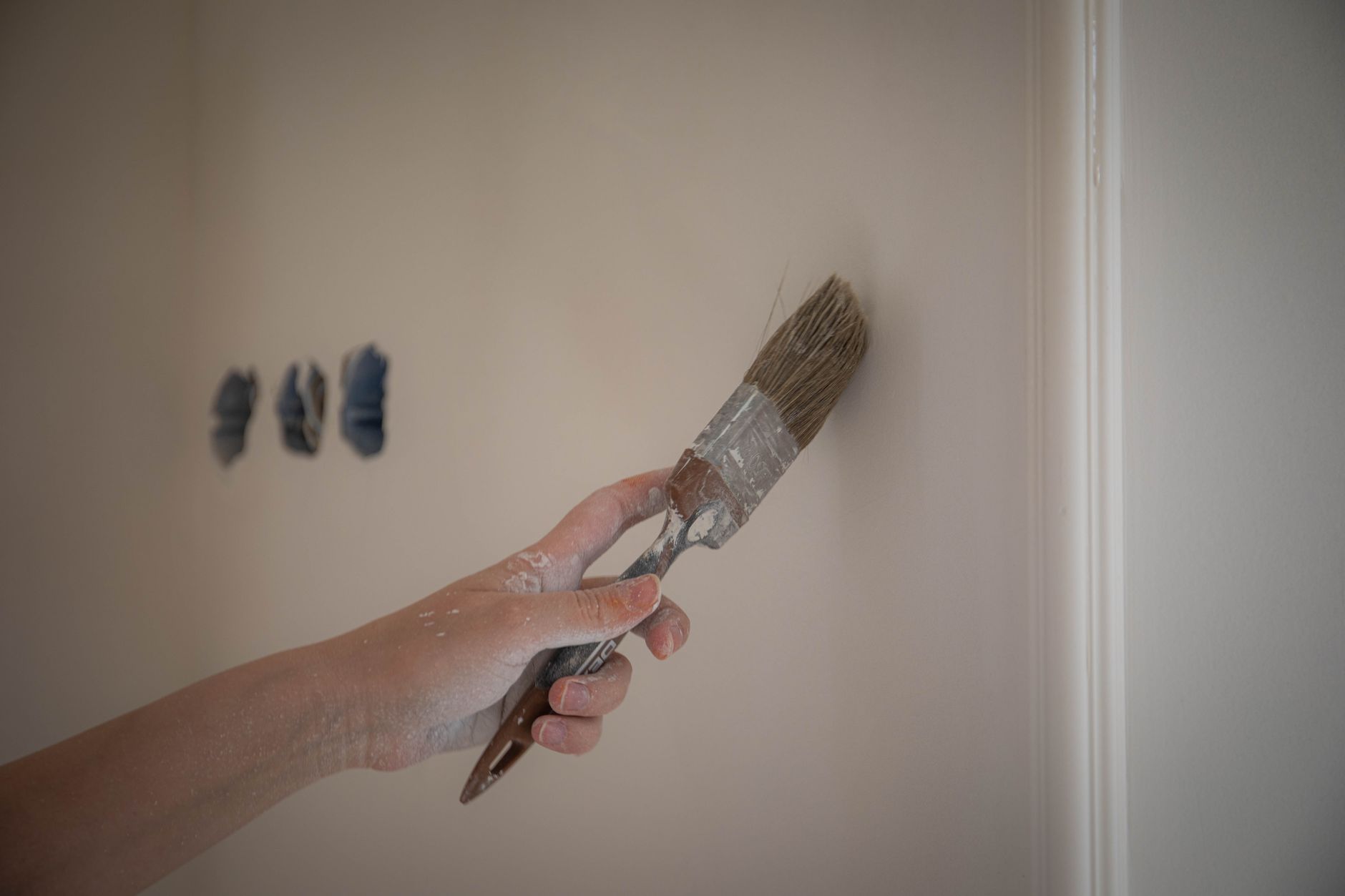
Paint touch-ups in occupied commercial spaces are one of the most underestimated maintenance tasks a business owner or facilities manager will face. The damage itself is usually minor: a scuff on a corridor wall, a chipped doorframe near the loading dock, a stain on a reception column. But fixing it badly is worse than leaving it. A mismatched patch on a branded feature wall tells every visitor that the building isn't cared for.
Why commercial touch-ups fail more often than full repaints
A full repaint starts fresh. Touch-up work has to meet an existing surface on its own terms, and that surface has aged. Paint oxidises, fades and picks up environmental pigment over time. Even a tin opened six months ago from the same batch will look slightly different on a wall that's been exposed to UV, foot traffic and cleaning chemicals.
Sheen mismatch is the most common failure point. A satin finish painted over a semi-gloss patch looks flat and obvious under fluorescent lighting, which is precisely the lighting most commercial interiors use. The angle of light in a retail or office environment is harsher and more consistent than at home, so imperfections don't hide. For more on how sheen levels perform under pressure, the guide to managing paint sheen on high-traffic commercial walls is worth reading before you buy a single litre.
The second failure point is over-application. Applying too much product to a small area creates a raised edge that catches the light differently from the surrounding surface. Thin coats, feathered at the edges, are the only way to keep a patch invisible.
Getting the colour match right
If the original paint specification is documented, pull it before ordering. Most commercial painters keep records of product codes and batch numbers, and Apex Painting retains job documentation so clients can request a colour match years after the original work was done. If records don't exist, a spectrophotometer reading from the wall surface is the most accurate alternative. Hardware store colour-matching machines work for residential jobs; for commercial applications where brand colours are involved, a professional match from the original paint manufacturer is worth the additional cost.
Dulux and Taubmans both offer colour matching services through their trade networks, and for large commercial accounts, custom tinting to a specific Pantone or RAL reference is standard. Don't accept a close match. Close matches look wrong in direct light, and they get worse as the existing paint continues to age.
Timing touch-ups in a working environment
Occupied commercial spaces don't go quiet. A medical clinic runs from 8am to 7pm. A logistics office runs shifts. A retail floor never really closes. Touch-up work needs to be scheduled around the actual rhythm of the space, not just before or after business hours in a general sense.
The key constraints are three: wet-paint contact risk from passing staff or customers, odour accumulation in enclosed areas, and the curing window before the surface is knocked again. Quick-dry waterborne formulations reduce the curing window significantly. Dulux Aquanamel, for example, is touch-dry in 30 minutes under normal conditions. That makes it practical for corridor and reception touch-ups during a lunch break without closing the area for a full day.
For areas with poor natural ventilation, odour management is not optional. The guide to managing paint odour in occupied commercial spaces covers the product and ventilation choices that keep air quality within safe limits while work is in progress. Low-VOC waterborne products reduce the problem substantially, but airflow still matters.
High-traffic areas need a different approach
Corridors, stairwells, lift lobbies and entry zones are where scuffs and chips accumulate fastest. They're also the hardest areas to touch up invisibly because the wear pattern on the existing paint is uneven. A fresh patch in the middle of a scuffed wall draws the eye directly to it.
The practical solution in high-wear zones is to extend the touch-up beyond the damaged area to a natural break: a corner, a doorframe, a change in surface. Painting from break to break blends the new product into the full field rather than isolating it as a rectangle. This takes more product and time than a spot fix, but it's the only approach that reads as maintenance rather than repair.
For walls that are scuffed below shoulder height across a long run, a full re-coat of the affected zone to waist height or to a dado rail is often more cost-effective than individual spot repairs. It's faster, it blends correctly, and it resets the surface for the next cycle of wear.
When to call a professional instead of handling it in-house
Facilities teams handle minor touch-ups routinely, and that's fine for back-of-house areas. But client-facing surfaces, branded feature walls, heritage finishes and surfaces near electrical or data infrastructure warrant a professional. The risk isn't the painting itself. It's the colour match, the sheen match, and the liability of getting it visibly wrong on a surface that represents the business.
Apex Painting provides commercial touch-up and maintenance painting across Melbourne, including scheduled maintenance visits for commercial clients who want scuffs, chips and stains addressed on a regular basis rather than as reactive call-outs. Reactive repairs always cost more per square metre than planned maintenance, because mobilisation costs are fixed regardless of patch size.
A maintenance schedule also integrates with broader property care. Keeping records of touch-up dates, products used and areas treated gives you a clear picture of where the original paint is deteriorating fastest, which informs the timing of the next full repaint cycle before failure becomes visible.