
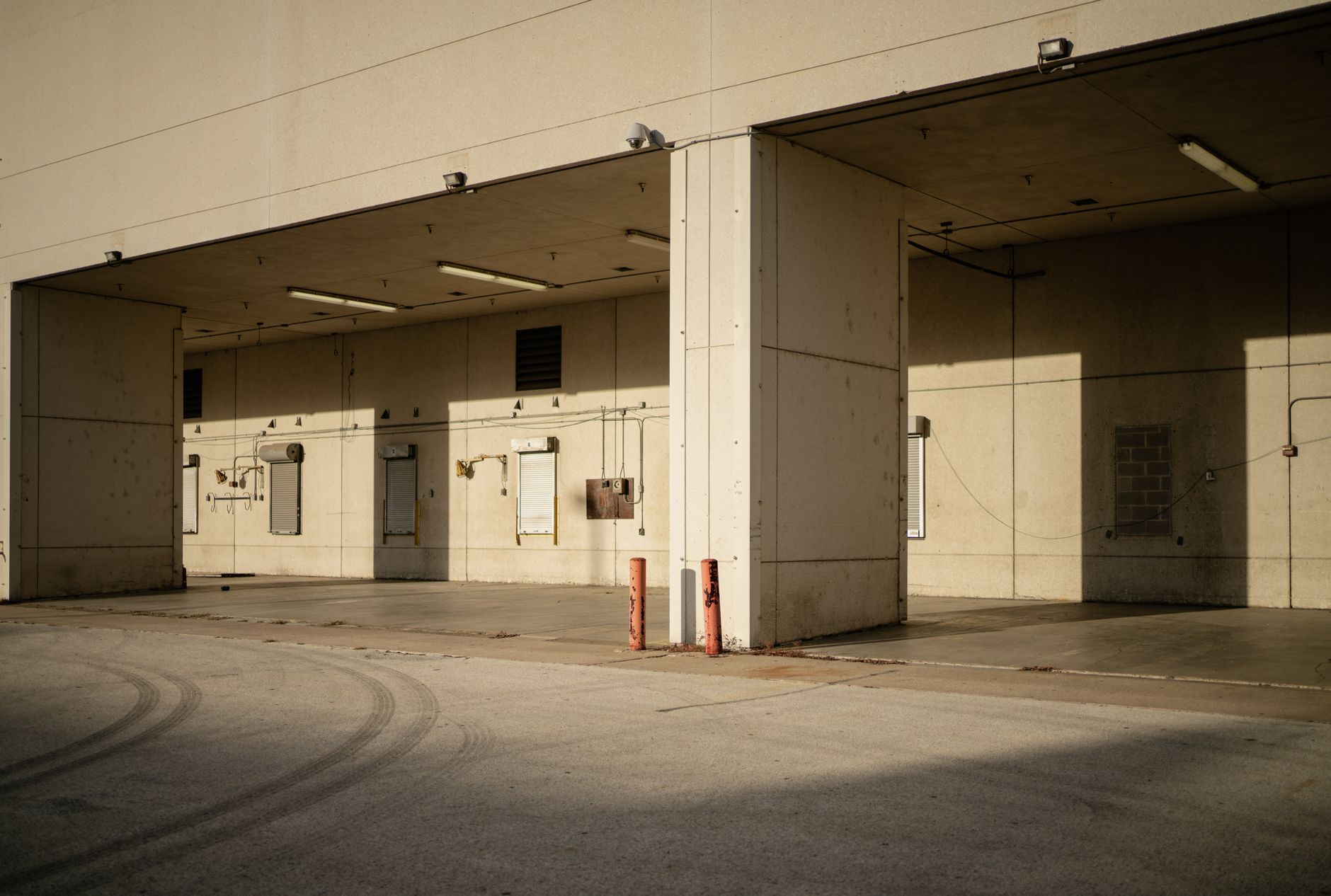
A commercial loading dock or warehouse entry takes punishment that virtually no other painted surface in a building faces. Forklifts clip walls. Pallets scrape skirting zones. Diesel exhaust coats every surface within metres of the door. Water pools at the threshold. And the work doesn't stop so the paint can cure properly. Standard commercial interior paint fails here within six to twelve months. The right approach requires different products, different preparation, and a realistic understanding of what the surface will actually face.
Why standard paint fails in loading dock environments
Loading docks sit at the intersection of interior and exterior conditions. The entry itself cycles through hot, cold, wet and dry air dozens of times a day as roller doors open and close. Concrete walls absorb moisture from the ground. Diesel particulates leave an oily film that resists adhesion. Impact from equipment is constant.
Paint films that work perfectly in offices and corridors simply aren't formulated for these stresses. A standard low-sheen acrylic will absorb impact rather than flex, chalk from UV exposure at the entry threshold, and blister where ground moisture migrates up through the slab. The fix isn't a heavier coat of the same product. It's a different product category entirely.
For walls in the impact zone (typically the lower 1.2 metres), a two-pack epoxy or a high-build polyurethane is the baseline. Both resist abrasion, repel diesel contamination and can be cleaned with alkaline detergents without film breakdown. Dulux Protective Coatings and Taubmans both produce industrial wall coatings suited to this environment. Above the impact zone, a satin or semi-gloss acrylic with a minimum 35 PVC (pigment volume concentration) performs well enough and is far easier to touch up.
Surface preparation: the step most people underestimate
Concrete block and tilt-up panel walls common in warehouse entries are alkaline, porous and often contaminated with release agent residue from the original form work. None of those conditions support paint adhesion without specific treatment. This is covered in detail in the Apex Painting guide on managing paint on commercial concrete tilt-up panels, but the loading dock environment adds a further complication: oil and fuel contamination at floor level.
Degrease the lower wall zone with a commercial alkaline degreaser before any mechanical prep. Don't assume a pressure wash is enough. Diesel and hydraulic fluid penetrate concrete and masonry, and water alone won't lift them. Let the wall dry for at least 48 hours after degreasing before you profile the surface.
Mechanical profiling matters more here than in most commercial environments. Concrete must reach a CSP (concrete surface profile) of at least CSP 2 before an epoxy primer will bond. A diamond grinder or captive-shot blaster achieves this. A light sand or hand abrasion does not. Skip this step and the epoxy delaminates within weeks, regardless of product quality.
Colour and marking considerations
Loading dock entries often need to carry safety markings: hazard banding, pedestrian exclusion zones, forklift travel paths. These aren't decorative. They're regulatory. In Victoria, AS/NZS 1742.7 covers traffic management in workplaces including internal traffic zones. Yellow and black hazard banding at dock edges and collision-risk columns should be planned into the paint specification from the start, not added as an afterthought.
Safety marking paints need to be compatible with the base coat system. Applying a water-based line marking product over a solvent-based epoxy wall finish without checking compatibility is a reliable way to produce adhesion failure in the marking layer within 90 days. Use the same manufacturer's system across base coat, wall finish and line marking wherever possible. It removes the compatibility question entirely.
Column wrapping is worth addressing separately. Columns in loading dock entries take direct impact from forklifts. Paint alone won't protect them. Physical column guards (polyethylene or steel) combined with a high-visibility paint treatment is the correct solution. The paint on a column is a visual indicator, not a structural defence.
Roller door reveals and threshold zones
The reveal around a roller door opening is a particularly demanding surface. It faces direct UV exposure when the door is open, repeated vibration from the door mechanism, and condensation from temperature differentials. Masonry paint formulated for direct-to-substrate use works in this zone. Full exterior-grade acrylic, not interior, is the right product choice here even though the location is technically inside the building envelope.
The threshold zone at floor level needs its own treatment. If the floor has an epoxy or polyurethane coating (which it should in a working dock), the wall coating should be brought down to meet it and lapped slightly onto the floor system with a coved sealant bead at the junction. This seals the most vulnerable point in the system against water ingress and chemical contamination. Skip it and you get a gap that holds water, grows mould and undermines both systems from the junction outward.
Sequencing work in a live facility
Most loading docks can't shut down for a week to accommodate a paint job. Sequencing matters. The order that works in almost every live facility is: degrease and profile over a weekend, prime immediately at the start of the following week when the surface is confirmed dry, apply base coat in sections, and finish line marking last when all other work is cured.
Two-pack epoxy systems have a pot life of 45 to 90 minutes depending on temperature and product. In a warm loading dock environment in summer, this shortens. Painters working with these systems need to mix smaller batches more frequently, not larger batches for convenience. A pot that's gone off produces a film with compromised cure, and the failure shows up three to six months later as delamination.
Odour management matters in facilities with adjacent office or staff amenity areas. Managing paint odour in occupied commercial spaces covers the product and ventilation strategies that keep solvent exposure within acceptable limits. Two-pack epoxies are particularly pungent. Water-based epoxy hybrids have improved significantly and are worth specifying in facilities with limited ventilation options.
Maintenance planning after the job
Even the right product system won't last indefinitely in a loading dock environment. Build a maintenance schedule into the specification from day one. A well-applied two-pack epoxy system on concrete block should hold for 5 to 7 years on upper walls and 3 to 5 years in the impact zone, assuming regular cleaning. "Regular" means a monthly wash with a commercial neutral or mildly alkaline detergent, not high-pressure water, which strips the surface profile over time.
Document the product system used, the batch numbers and the application dates. When touch-up work is needed in year two or three, the paint contractor needs to know exactly what's on the wall to achieve a colour and sheen match. An undocumented system means a new contractor is guessing, and a guess in a two-pack environment produces adhesion failures at the join between old and new film. Keep the specification sheet and the product data sheets filed with the building maintenance records.
Apex Painting delivers commercial painting services across Melbourne for warehouse, industrial and logistics facilities. For projects involving expansion joints and control joints in the dock floor or adjacent walls, proper joint treatment needs to be coordinated with the paint specification before work starts.