
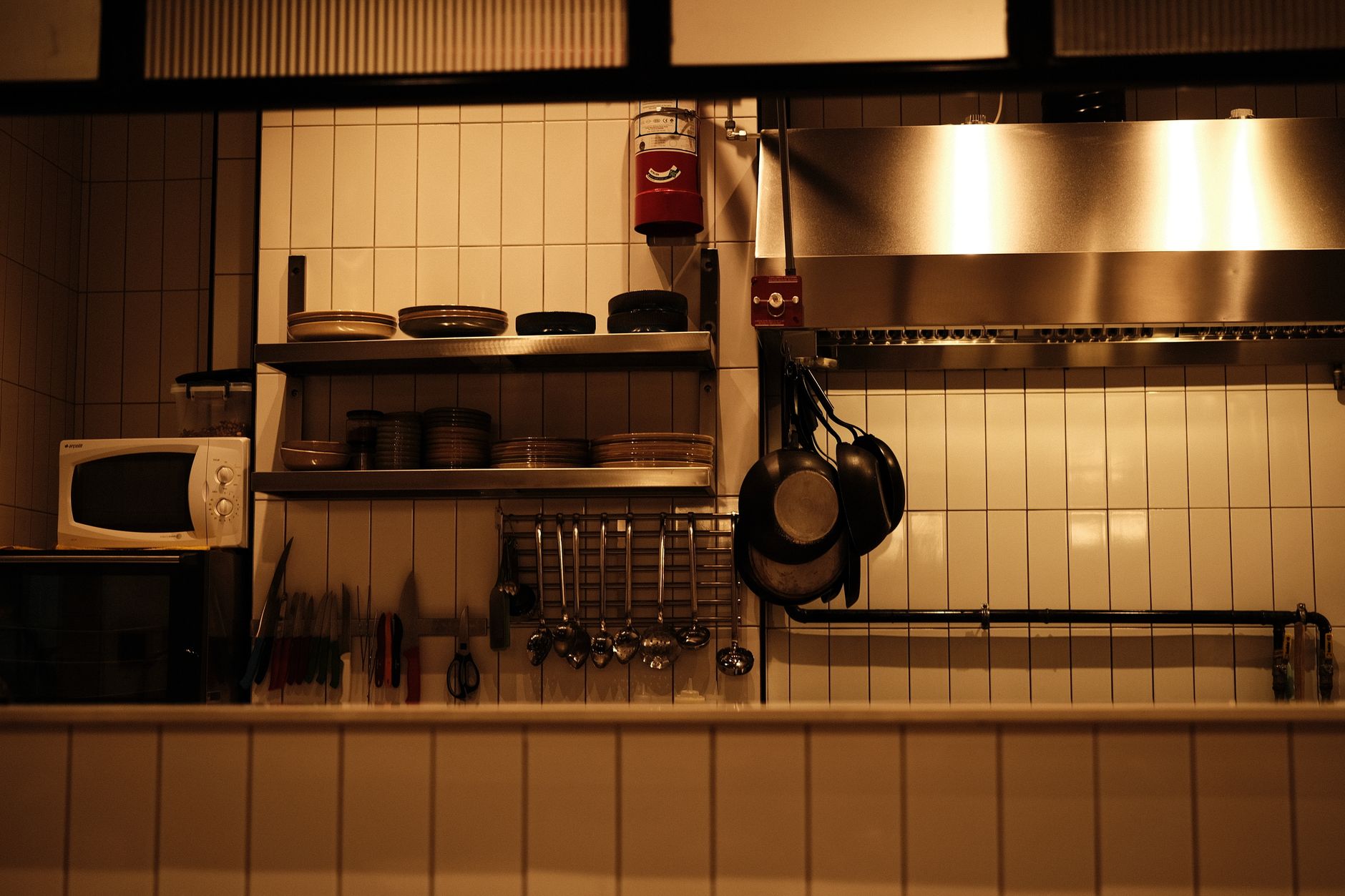
Commercial kitchens and food preparation areas ask more of paint than almost any other surface in a building. Heat spikes to 60°C or higher near cooking lines, steam saturates walls around dishwashing stations, and cleaning crews hit surfaces with alkaline degreasers or quaternary ammonium sanitisers multiple times a day. A standard interior wall paint fails in months under those conditions. The right product, applied correctly, can hold for three to five years between maintenance cycles.
Why standard commercial paints don't work here
Most commercial interior paints are formulated for offices, corridors and retail spaces. They handle foot traffic and the odd wipe-down, but they aren't built for thermal cycling, saturated steam or repeated chemical exposure. The film softens, adhesion breaks at seams and corners, and moisture gets behind the paint where grease and mould establish quickly. Once that cycle starts, repainting over the problem just delays it.
Food-safe environments also carry a regulatory dimension. In Victoria, commercial food businesses operate under Food Standards Australia New Zealand requirements that include wall and ceiling surface standards. Surfaces must be smooth, impervious and cleanable. A paint film that has started to flake or blister fails that test, and an environmental health officer visit can force a shutdown until it's remediated.
What to specify for walls in a commercial kitchen
The two product categories that perform reliably in commercial kitchen environments are two-pack epoxy coatings and high-build polyurethane finishes. Two-pack epoxies cure to a hard, chemically resistant film that withstands the pH range of commercial cleaning products and won't soften under sustained heat. Polyurethane finishes are more flexible, which suits surfaces prone to minor movement or vibration, and they hold colour better under UV if any exterior-facing walls are involved.
For most standard kitchen walls, a two-pack water-based epoxy applied at 100–150 microns dry film thickness is the practical choice. Dulux and Wattyl both manufacture commercial-grade epoxy wall coatings available through trade channels. Specify a semi-gloss or gloss sheen: lower sheens trap grease in the surface texture and become impossible to clean hygienically. Flat and low-sheen finishes have no place on a kitchen wall.
Colour matters too. Light colours, particularly whites and light greys, make contamination visible, which supports cleaning compliance. A dark wall in a food prep area can hide grease build-up, and kitchen managers find that a simple thing. Most health inspectors prefer light-toned surfaces in high-risk zones for exactly this reason.
Ceilings and bulkheads above cooking equipment
Ceilings directly above commercial cooking lines face a different problem to walls. Grease vapour rises, condenses on the ceiling, and then gets cooked by the heat radiating back up. Standard ceiling paint becomes sticky within weeks. The finish turns yellow, then brown, and cleaning strips it.
Above cooking equipment, specify the same two-pack epoxy system used on walls, not a standard ceiling product. The application is more demanding because working overhead with a heavy coating requires proper scaffolding and spray equipment rather than a roller. Apex Painting uses airless spray systems for commercial ceiling applications in kitchens, which delivers a more even film build than rolling and avoids the texture variation that traps grease. For guidance on handling commercial ceiling surfaces more broadly, the approach to commercial ceilings and bulkheads outlines what a proper specification looks like.
Surface preparation: the step most painters skip
No epoxy coating performs on a poorly prepared substrate. In a commercial kitchen, the substrate problem is almost always grease contamination. Even a kitchen that looks clean to the eye will have a layer of polymerised grease on every wall within three metres of the cooking line. Sand that surface without cleaning it first and you grind grease into the profile rather than removing it.
Preparation for a commercial kitchen repaint requires:
- A hot alkaline degreaser wash (minimum 60°C water temperature) applied by pressure washer or scrubbing, followed by a clean water rinse and complete drying time.
- Sanding or abrading the existing surface to break gloss and give the epoxy mechanical adhesion.
- Spot-filling cracks, holes and joints with an epoxy filler rated for wet areas. Cementitious fillers are too porous for this environment.
- A solvent-based epoxy primer on any bare substrate exposed by the sanding process, particularly around tile junctions or stainless steel brackets.
Skipping the degreasing stage is the single most common reason epoxy coatings fail prematurely in food prep areas. The coating looks fine for a month, then delaminates in sheets.
Scheduling around kitchen operations
A commercial kitchen repaint cannot happen while the kitchen is operating. Two-pack epoxy products emit solvents during application and cure, and those solvents have no place near food. The minimum approach is a full shutdown of the area being painted, with adequate ventilation running throughout the application and the initial cure period, which is typically 12 to 24 hours depending on product and temperature. Reoccupation before full cure means the surface can be marked or contaminated before it's actually hard.
For larger kitchens, a staged approach works well: section off and repaint one zone at a time, working from the back of the kitchen toward the service pass. This keeps at least partial operation running and avoids the cost of a full shutdown. The same logic applies to managing any occupied commercial space during a paint job, and the principles covered in handling paint touch-ups in occupied commercial spaces translate directly to kitchen staging.
Night-shift painting is the other option for high-volume kitchens that operate through most of the day. It's a legitimate strategy, but it requires confirming that the space can be properly ventilated after hours and that no food production restarts before the coating has cured.
Maintenance and inspection intervals
Even a correctly specified and applied epoxy system won't last indefinitely in a commercial kitchen. Inspect the coating at six-month intervals for the following:
Chipping at corners and edges near equipment is the earliest failure mode. Stainless steel trolleys, racks and tray slides hit the same spots repeatedly, and once the edge coating chips back, moisture and grease get underneath the film. Spot repairs at these locations, using the original epoxy product, extend the life of the full coating significantly. Leave it unaddressed and the delamination spreads.
Discolouration around extraction canopies indicates that grease is depositing on the surface faster than cleaning removes it. That's a ventilation problem first, a paint problem second. Fixing the extract system before repainting is far more cost-effective than repainting and watching the same staining return.
A well-maintained epoxy system in a mid-volume commercial kitchen typically reaches the four-year mark before a full repaint is warranted. High-volume operations, particularly those running two or three service sessions per day, realistically repaint on a two to three year cycle.