
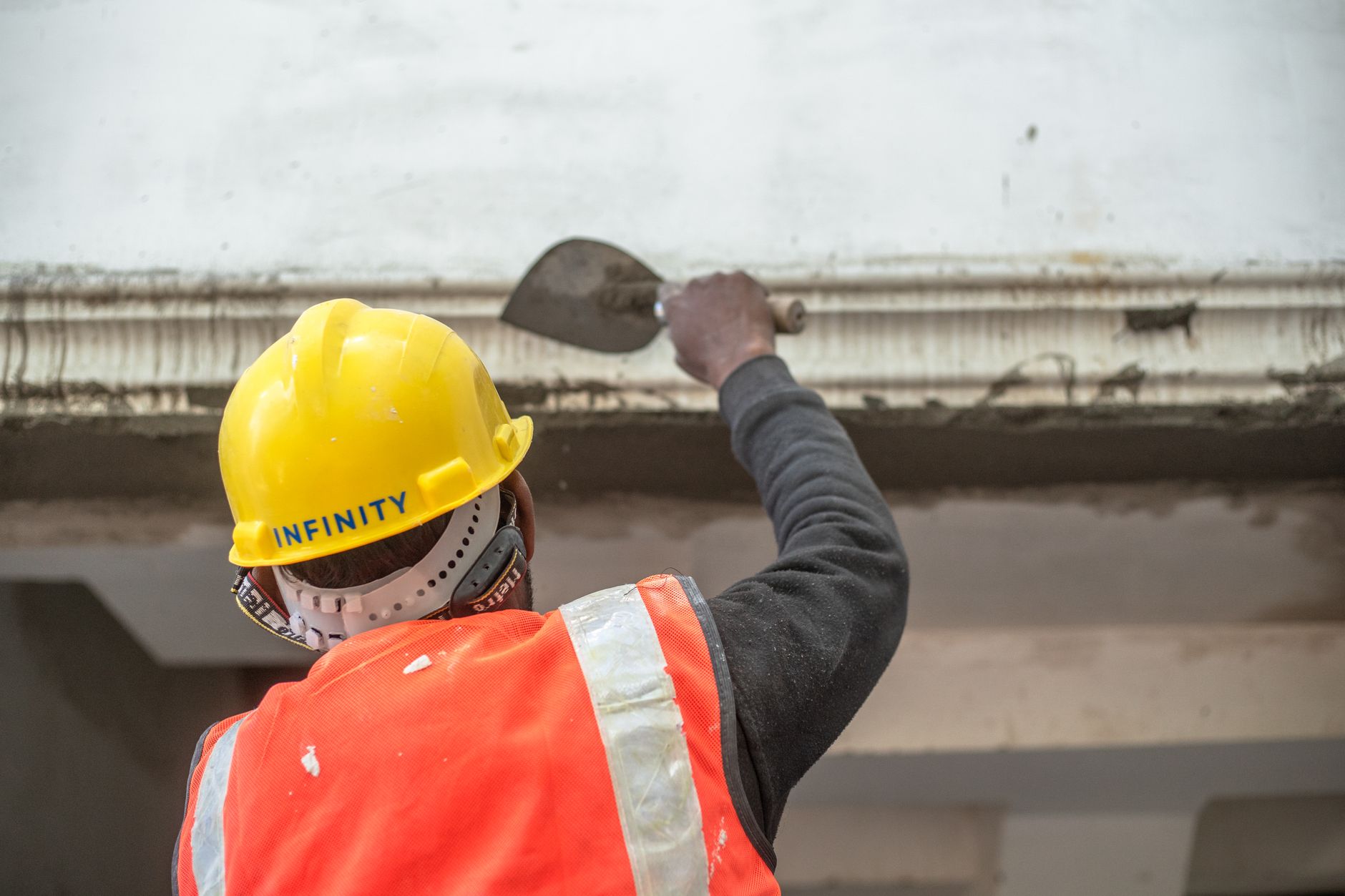
Commercial ceilings and bulkheads carry more visual weight than most people realise. A perfectly painted wall loses its impact the moment a client glances upward and sees a patchy, shadowed ceiling above it. Yet in most commercial fit-outs, the ceiling is the last surface to get serious attention and the first one to show it.
Apex Painting handles commercial ceiling and bulkhead work across Melbourne offices, retail spaces and hospitality venues. The challenges are consistent: height, surface complexity, occupied spaces and the unforgiving way overhead light exposes every flaw.
Why commercial ceilings are harder than walls
Gravity works against you. Paint that's slightly too thin runs. Rollers overloaded with product leave heavy stipple marks that harden into texture you never intended. Add recessed lighting that rakes across the surface at a low angle, and imperfections become impossible to ignore once the fit-out is complete.
Bulkheads create a second problem. A bulkhead is a dropped section of ceiling, usually used to box in services like ducting, cabling or pipes. It creates a junction between two planes at different heights, and that junction is where paint failures concentrate. The corner between a flat ceiling and a vertical bulkhead face collects movement, which means cracks appear there first, especially in commercial buildings where HVAC systems run continuously and thermal cycling is constant.
Surface prep at that junction matters far more than the paint brand you choose. Without proper filling, priming and flexible sealant at the junction, even premium products will crack within 12 months.
Surface preparation: what actually matters
The preparation sequence for a commercial ceiling follows three non-negotiable steps.
- Fill and sand. Plasterboard joins, screw holes and existing cracks all need filling with a setting-compound filler (not a flexible filler at this stage). Sand flush once dry. Two coats are usually needed on any join wider than 3 mm.
- Prime everything. New plasterboard absorbs paint unevenly. Unpainted sections drink the first coat and leave sheen differences that no amount of topcoating corrects. A PVA-based sealer primer applied before the topcoat fixes this.
- Flexible sealant at junctions. Where ceiling meets bulkhead face, and where bulkhead meets wall, use a paintable acrylic sealant. It accommodates movement without cracking. Smooth it with a wet finger before it skins over, and let it cure fully before painting over it.
Skipping any of these three steps creates a job that looks fine on handover and disappoints by the third month.
Product selection for commercial ceilings
The finish matters as much as the base. Flat and low-sheen finishes are standard on commercial ceilings because they absorb light rather than reflect it, hiding surface irregularities better than semi-gloss. However, flat finishes aren't washable, so in commercial kitchens or food-service areas, a low-sheen product that tolerates cleaning is worth the extra cost.
Bulkhead faces present a choice. If the bulkhead face is painted the same colour as the ceiling, use the ceiling product. If it's painted the same as the adjacent wall, use the wall product and match the sheen level exactly. A bulkhead face painted in ceiling-flat next to a wall in low-sheen will catch the light differently, creating a visible band that looks like a mistake even when the colour is technically correct.
Dulux and Taubmans both produce commercial-grade ceiling whites with high hide and a consistent flat finish that holds up under LED and fluorescent lighting. The product choice is less important than matching the sheen across all surfaces at the same plane.
Application technique for flat ceilings
Work in manageable bays. On a large commercial ceiling, trying to roll the entire area in one pass leads to lap marks where wet edges dry before the adjacent section is joined. For a standard office ceiling, divide the space into 4-metre bays and cut in each bay before rolling it. This keeps a wet edge throughout the application.
Roll with a 12 mm nap on smooth plasterboard. Longer naps introduce texture. On textured ceilings, match the existing texture with a 20 mm or 25 mm nap roller. Two thin coats outperform one heavy coat on every commercial ceiling job.
If the space is occupied, low-odour products cut disruption significantly. Apex Painting uses water-based low-VOC products in occupied commercial environments as standard. The detailed approach to managing paint odour in occupied commercial spaces is worth reviewing before any ceiling job in a live building.
Bulkhead detailing: getting the lines right
The horizontal top edge of a bulkhead face is the hardest line to cut cleanly. You're cutting in overhead, often with limited sight lines, and the line needs to be sharp because it runs the full length of the bulkhead where the eye follows it naturally.
Use a quality angled sash brush, not a flat brush, for this cut. Load it lightly and pull it steadily in one direction. Don't go back over a section that has started to skin. If a line needs correcting, wait until the coat is fully dry and apply a second pass.
Masking tape is an option, but it introduces its own risks on freshly painted surfaces. If tape pulls existing paint at the edge, the repair is more difficult than the original cut. For bulkhead work in particular, a steady hand and the right brush produces a cleaner result than tape in most situations.
Managing access in commercial spaces
Height is the practical barrier on most commercial ceiling jobs. Ceilings in commercial buildings typically sit between 2.7 and 4 metres. A domestic ladder isn't rated for commercial use and creates occupational health and safety issues.
For ceilings up to 3 metres, a rated platform ladder with a tool tray handles most of the work. Above 3 metres, a scaffold or elevating work platform is the right tool. The time cost of proper access equipment is recovered in quality and safety. Rushed ceiling work from an undersized ladder produces the lap marks, misaligned cuts and dropped paint that define a poor commercial finish.
Timing ceiling work to occur before or after business hours reduces access conflicts in occupied spaces. Apex Painting typically schedules ceiling and bulkhead work outside peak hours on commercial sites, particularly in areas like reception, boardrooms and client-facing retail floors. For a broader look at managing live-site painting logistics, the guidance on paint touch-ups in occupied commercial spaces covers the scheduling principles that apply equally to ceiling work.
Common mistakes and how to avoid them
The three mistakes Apex Painting corrects most often on commercial ceiling jobs are: insufficient primer on new plasterboard (fix: always prime, always), wrong sheen on bulkhead faces (fix: match the adjacent plane), and no sealant at junctions (fix: non-negotiable). Each one is easy to skip under time pressure and expensive to rectify once the fit-out is complete.
A commercial ceiling painted properly disappears. It does its job without drawing attention. That's the standard worth holding to.