
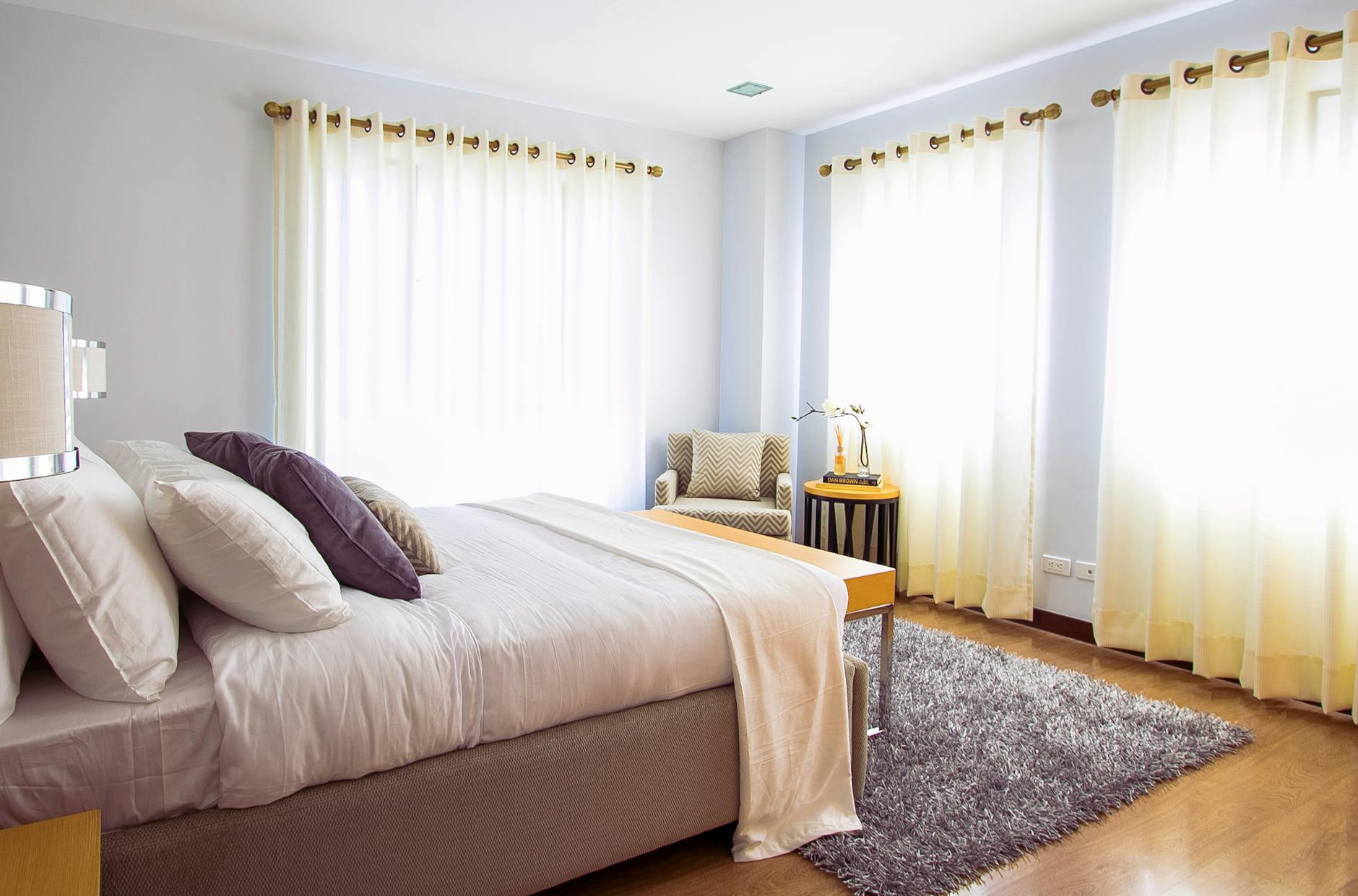
A west-facing bedroom presents one of the trickier colour challenges in any home. The room sits in cool, flat morning light for half the day, then floods with warm amber afternoon sun from around 2 pm onward. A colour that reads as soft grey at 9 am can glow almost orange by 5 pm. Choosing paint colours for a west-facing bedroom means picking a palette that works through both conditions, not just one.
Why west-facing rooms are harder to colour than east-facing ones
East-facing rooms receive their brightest light in the morning, then soften into neutral afternoon shade. The light is cooler and more stable overall. West-facing rooms do the opposite: they warm up dramatically as the day progresses. That shift is more extreme in Melbourne, where afternoon sun in summer can be genuinely harsh.
The practical consequence is that any colour with a warm undertone gets amplified in the afternoon. A beige that looks sophisticated on a sample card can turn caramel under direct western sun. Blues and greens with yellow undertones drift toward lime or olive. Even a mid-grey with a slight red undertone can read as dusty rose in strong afternoon light. This is the core problem to solve.
For a deeper look at how light direction shapes colour decisions room by room, the article on how to choose paint colours for an east-facing room is a useful comparison point. West-facing rooms call for almost the opposite approach.
What colours work well in a west-facing bedroom
The goal is to choose colours with cool or neutral undertones that can absorb afternoon warmth without tipping into something you didn't intend. Here's what tends to hold up:
- Cool whites and off-whites: look for whites with a green or blue base rather than a cream or yellow one. Dulux Vivid White is too stark for most bedrooms, but a cool off-white like a soft stone with grey-green undertones reads as calm rather than washed-out in intense western light.
- Muted blue-greens and sage tones: these absorb warm afternoon light without clashing. They shift slightly warmer in the afternoon but stay within a pleasing range. Avoid anything with a yellow undertone.
- True mid-greys: a grey with a blue or cool green base handles the afternoon shift well. Avoid warm or purple-based greys, which can look pink by 4 pm.
- Dusty or greyish blues: genuine blue tones, not navy, tend to hold their character even under strong warm light. They provide a natural counterbalance to the amber shift.
Colours to avoid
Warm tones are the obvious risk, but they're not the only one. Yellow-based neutrals are the most common mistake in west-facing bedrooms. Pale yellows, warm creams and sandy beiges all respond badly to afternoon sun because the room's natural light amplifies their warmth rather than softening it. By evening the walls can feel oppressive rather than cosy.
Terracotta and rust tones have the same problem at a more extreme level. They're popular in Melbourne at the moment, and in a south or north-facing room they can look grounded and rich. In a west-facing bedroom they become overwhelming once the afternoon sun hits. The same applies to deep mustard and orange-adjacent neutrals.
Understanding the relationship between warm and cool tones is worth getting right before committing to a palette. The article on warm vs cool paint colours breaks down the practical differences and how to test them in your own space.
How to test colours before committing
Sample testing is essential for any room. For a west-facing bedroom, it's non-negotiable. Paint at least an A3-sized patch directly on the wall, not on a piece of card or paper. Card bends and catches light differently.
Check the patch at three specific times: around 8 am, around 12 pm, and again at 4 pm. That last check is the one most people skip, and it's the most important. The 4 pm reading tells you what the room will look like every afternoon of the year. If the colour has shifted significantly toward warmth or the undertone has become visible in a way you dislike, it's not the right choice for this room.
Keep the sample on the wall for at least two full days before deciding. Melbourne's afternoon sun varies with cloud cover, and a single day can be misleading. Paint the sample on the largest uninterrupted wall section, away from windows and corners where light pools differently.
What to do with dark colours
Dark colours in a west-facing bedroom can work surprisingly well, provided the undertone is right. Deep charcoal with a blue base, forest green, and inky navy all absorb afternoon light rather than reflecting it back. The room won't glow orange in the afternoon because the colour is dense enough to hold its own against the light shift.
The risk with dark colours in any bedroom is that they can feel heavy at night under artificial light. Balance this with warm-temperature downlights (around 2700–3000 Kelvin) and natural timber or linen textures to keep the room feeling comfortable after dark rather than cave-like.
If you're considering going dark on a feature wall rather than all four surfaces, the principles of using dark paint colours without shrinking a room apply directly here. West-facing bedrooms with dark feature walls facing into the room can feel deliberately dramatic rather than oppressive.
Ceiling and trim considerations
In a west-facing bedroom, a warm ceiling colour will compound the afternoon light shift considerably. Stick with a true white or a very pale cool tone on the ceiling. Dulux Antique White USA, despite the name, reads cooler than most warm off-whites and is a reliable ceiling choice that doesn't fight the wall colour.
For trim and architraves, a crisp cool white creates separation and prevents the room from feeling like it's glowing from all surfaces at once. If the wall colour is a very cool or saturated tone, a semi-gloss white trim provides enough contrast to keep the room feeling structured. Avoid using the wall colour on the trim in a west-facing bedroom. The effect can look sophisticated in other orientations but tends to merge into a haze under strong afternoon sun.
Sheen levels for a west-facing bedroom
Finish matters as much as colour in a room with strong directional afternoon light. High sheen finishes bounce afternoon sun across the room, creating glare and making colour shifts more dramatic. A low-sheen or flat finish absorbs light rather than reflecting it, which moderates the afternoon shift and keeps the colour looking closer to what you selected.
For a west-facing bedroom, a low-sheen or matte wall finish is almost always the right call. Keep the semi-gloss for the skirting boards and architraves only, where the practical benefits of washability justify the reflectivity. The ceiling in flat white sits outside the problem zone altogether because it catches light from above rather than from the side.
Getting the sheen level wrong is one of the most common reasons a west-facing bedroom feels uncomfortable in the afternoon. The colour looks right on the sample card, the patch test looks promising at noon, and then the afternoon sun hits a satin finish and the room becomes a different space entirely.
A note on curtains and blinds
Paint colour doesn't exist in isolation. In a west-facing bedroom, block-out or block-out-lined curtains have a direct effect on how the wall colour reads in the late afternoon. Heavy linen or wool drapes in warm tones add warmth to the room even when drawn back, which shifts the overall palette. If you plan to use warm-toned soft furnishings, compensate with a cooler wall colour than you'd otherwise choose. The two elements interact, and the balance point is different for every room.
Apex Painters Melbourne provides professional painting services across Melbourne's residential suburbs, with experience in colour selection across all room orientations. If you'd like help testing and confirming a palette before committing, Apex Painters Melbourne can advise on product selection and undertone behaviour for your specific room.